

Partager

The Montessori educational approach, developed by Maria Montessori, is based on a deep understanding of the different stages of a child's development. It is characterized by its holistic approach, considering psychological, intellectual, and physical aspects of growth. At KidsCare in Luxembourg, our daycare centers are designed following this method, so it is essential for us to understand these stages in order to provide an environment conducive to your child's development.
J'inscris mon enfant dès maintenant
The Key Stages of Development According to Montessori
Maria Montessori identified four main phases in a child's development, each marked by specific characteristics and particular needs.
1. From birth to 6 years: Early Childhood
From 0 to 3 years: The Early Years
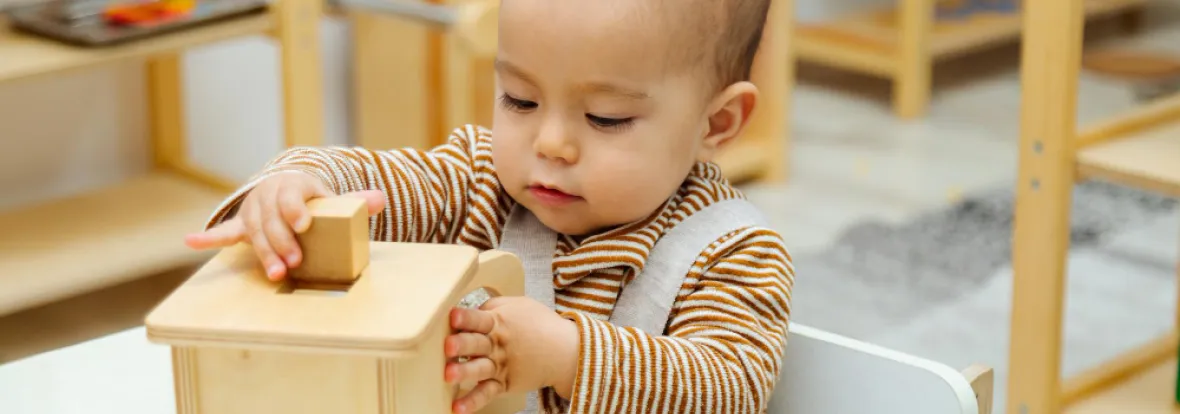
This first phase begins at birth and is divided into two sub-phases. From 0 to 3 years, toddlers absorb their environment in an entirely unconscious manner. During this period, the brain is highly plastic, and babies primarily learn through what is called sensory absorption. Interactions with parents and everyday objects play a crucial role, which is why, at KidsCare, we provide a prepared and adapted environment for children.
- Motor skills and senses: Motor and sensory abilities develop rapidly. Children learn to coordinate their movements and refine their senses through practical activities.
- Language: Language acquisition is a key stage. Children start by babbling and gradually form words and simple sentences.
From 3 to 6 years: Emerging Awareness
From 3 to 6 years, children begin to develop a more structured awareness of their environment.
- Autonomy: They seek to do things on their own, which helps build their independence and self-confidence.
- Sensitive periods: Maria Montessori identified sensitive periods when children are particularly receptive to certain types of learning, such as language, fine motor skills, and social relationships.
2. From 6 to 12 years: Middle Childhood
This period is marked by intellectual and social expansion.
- Reason and imagination: Children develop rational thinking and imagination. They begin to understand abstract concepts and ask questions about the world around them.
- Social interactions: Relationships with peers have become very important. Children learn to work in groups, collaborate, and resolve conflicts.
- Exploration: They are curious and explore various subjects, often with intense passion. Montessori's materials used at this age particularly encourage research and investigation.
3. From 12 to 18 years: Adolescence
Adolescence is a period of intense transformation, both physically and emotionally.
- Identity and autonomy: Adolescents seek to define their identity and gain independence. They frequently question the values and rules imposed by adults.
- Intellectual abilities: Their ability to think critically and abstractly develops fully. They can analyze complex situations and reflect on philosophical concepts.
- Practical projects: Maria Montessori proposed practical and entrepreneurial projects for adolescents, allowing them to apply their knowledge in real-world contexts and prepare for adult life.
4. From 18 to 24 years: Young Adulthood
This final phase prepares individuals to enter adult life in an autonomous and responsible manner.
- Maturation: Young adults refine their skills and begin to specialize in particular areas.
- Financial and social independence: They become more financially and socially independent and begin to play an active role in society.
- Relationships: Personal and professional relationships take on a new dimension. They learn to manage increased responsibilities and build stable and enriching relationships.
J'inscris mon enfant dès maintenant
The Role of the Prepared Environment
The Montessori prepared environment is designed to meet the specific needs of children at each stage of their development:
- Adapting the environment: At home or in school, it is important to create a space that allows children to move freely and explore. In our daycare centers and nurseries, objects and materials are arranged to encourage autonomy and learning.
- Montessori's materials: Montessori materials are designed to be attractive and educational. For example, observation towers and building blocks help young children develop fine motor skills and coordination on a daily basis.
- Observation: Adults, whether educators or parents, play a role as caring observers.
The Importance of Sensitive Periods
Each child goes through sensitive periods where they are highly receptive to certain types of learning, such as:
- Language: Between 0 and 6 years, children are in a sensitive period for language acquisition. Verbal interactions, songs, and readings are essential to developing their linguistic skills.
- Motor skills: Activities that develop fine and global motor skills are crucial, especially between the ages of 3 and 6. Construction games, manual activities, and physical exercises are particularly beneficial.
Understanding the stages of development according to Montessori helps create an environment conducive to the flourishing of children at every age. In Luxembourg, these principles can be implemented both at home and in school to provide your children with the best conditions to grow and thrive. At KidsCare, we enable babies and children to develop their intellectual, emotional, and motor skills harmoniously by:
- Respecting sensitive periods
- Adapting the environment
- Offering stimulating Montessori activities, both indoors and outdoors
J'inscris mon enfant dès maintenant